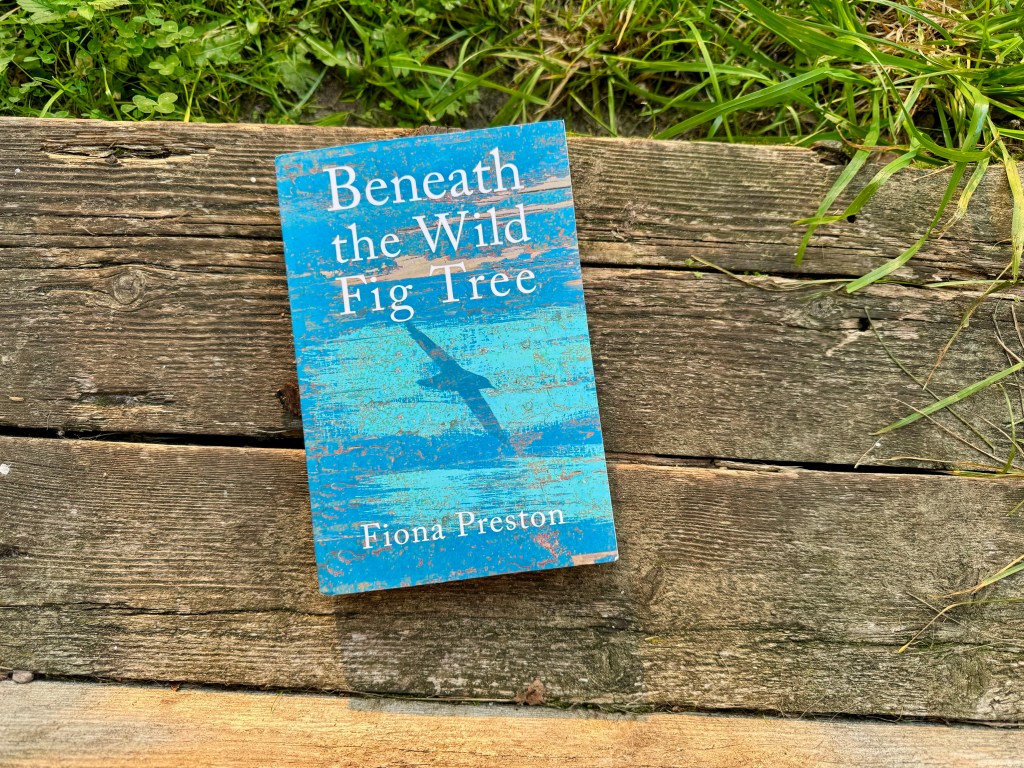
On an island in a Bass Strait (a strait separating the island state of Tasmania from the Australian mainland), across Hobart, Sydney and Adelaide, a family drama unfolds. A decision must be made – to forgive or to nurture a grudge. A traveller obsessed with the ocean. A conflicted archaeologist. A girl who thinks parents should never be trusted. “Beneath the Wild Fig Tree” interweaves 1984 and the year 2000 into a compelling story about coming of age, betrayal and self-discovery, grief and happiness, and the luminosity of the natural world.
“Beneath the Wild Fig Tree“, published today, on September 27, is a debut novel by Australian writer Fiona Preston. She was born in South Africa but has spent most of her life in Australia, specifically in Luturwita / Tasmania. She has also lived in the remote Kimberley region of Western Australia and in New South Wales. She currently lives in a small coastal community with her husband and a dog. She has blogged about exploring coastlines of Tasmanian beaches.
Back in summer Fiona reached the Sea Library via e-mail and I had the unique chance to read the book before it was published. Engrossing, interwoven and compassionate, this novel absorbed me like an old notebook found in a box, like an island with a cave full of dreams. And I swear I could hear Australian wildlife buzzing, hissing and chirping from its pages. This week the printed copy arrived all the way from Australia to the coast of the Baltic Sea. It’s beautiful.
I started to read it in my garden in the sun and finished traveling home by train. I was completely engulfed by it. First, I really believed that it was a memoir, not a fiction. Then – I started to dream enchanted dreams of my own, as the island would have an effect not only on its inhabitants but on readers too. One night I dreamt of a small wooden house built on a huge block of a glacier, so that the floor of that house was ice in the colour of an amazonite stone and by shuffling your feet, you could clean a thin layer of snow away. The book was full of love for sea and nature. I enjoyed my time on that island so much.
Fiona Preston kindly offers a chance to read an excerpt from the book online. Also, first three who will read this interview and contact Fiona via here, will receive free digital copies of the whole book!
After reading “Beneath the Wild Fig Tree” I had many questions that I wanted to ask. Thank you, Fiona, for your time answering these for the Sea Library Magazine.
How does it feel now that “Beneath the Wild Fig Tree” is published and ready to embark on its journey to readers?
I love that you use the word journey because both the writing and the publishing have been epic, full of emotion and adventure, moments of exhilaration, but also of gloom.
Right now I feel so satisfied to be able to hold it in book format. It changes my relationship to it – no longer a naked manuscript, but well-dressed and ready to go out into the world.
This novel’s first overseas trip was to Latvia. I find that just a little bit thrilling! I’m so interested to see where else around the globe it finds its readers.
Can you share how this story came to you and how long did you work on it?
It started off in a most unlikely genre then took a giant leap into another.
When my daughter was a pre-schooler, she was obsessed with Ludwig Bemelman’s Madeleine books and so I started making up stories about Madeleine visiting her friend on an island to help her understand my husband’s field trips to remote places around Tasmania.
When she moved on from Madeleine, I had three characters and a dog stuck on an island and I began to wonder, from an adult perspective, about who they were and what they were doing there. Quite quickly they began to blossom into dynamic, complex characters willing to grow alongside me over the years, and their story shifted into literary fiction.
I began it in 1994 and ‘finished’ it in the year 2000. I sent it out to publishers and found a lovely one but after the initial high, I gave in to the feeling of it not being the right time and I let that opportunity fade away. Roughly every five to seven years I’d revisit it and change the structure, add additional layers, thread another storyline through it and give it a polish. It was like a fieldtrip for me, visiting old friends. It’s also been a bit like doing a painting and not knowing when it’s finished because even now I can think of aspects I’d liked to have deepened.
Last year, when I reconsidered publishing, I discovered indie publishing had come of age, although I don’t feel that’s quite the case for for literary fiction. It’s the science fiction and romance writers leading that charge. But it looked like fun as opposed to joining a myriad of other writers in competition for the 1% chance of getting published, and in any case I’d had my chance and let it go. But I decided the time was right given Australia had just had a national reckoning – a referendum to do with Aboriginal rights and the result, as far as I was concerned, was extremely disappointing.
This novel, I hope, might remind Australians of a moment of optimism during the year 2000.
As I read your book, I couldn’t help but be reminded of Tove Jansson’s “Moominpappa at Sea” (1965) and Kiran Millwood Hargrave’s “Julia and the Shark” (2021). Both feature teenagers journeying to an island with a lighthouse, prompted by their parents’ choices. In each narrative, the protagonists uncover something extraordinary in the wilds around them and forge a meaningful friendship. I’m curious—what books have influenced your writing the most?
Thank you for those titles. I’ll look them up! I was influenced by the nature writing movement in the USA. I was a keen reader of Orion Magazine and writers like Annie Dillard and Barry Lopez, and I wanted to try fusing nature writing with fiction, Editors are useful. Mine helped me trim nature back a bit to give the story clear breathing space so it picked up pace.
I was two or three years into my work when I discovered Barbara Kingsolver’s Animal Dreams and I felt quite exhilarated by that – of finding a fiction writer with a feeling for place and an appreciation of nature. It’s not like there weren’t others, but it was a timely discovery that helped me feel validated in what I was trying to do.

What does a lighthouse represent for you? Its significance is profound, both in the physical world and as a metaphor. It’s no surprise that so many are captivated by their allure…
As a child in South Africa we’d often stay at our grandparents’ house near the mouth of the Buffalo River. It’s Africa’s only river port, and it has a harbour light. At night, sitting on the porch, I’d stargaze with my grandfather and watch the beam from the lighthouse sweep across the sky.
In Tasmania, the Goose Island light, and the lighthouse at Larapuna were the inspiration for the one in the novel. They are always so emphatic in a landscape and a reassuring sight when you’re sailing a stormy sea, and I was doing just that one night, and the Larapuna light was a big solace!
I was also reading a fair bit of Jung at the time, so that found it’s way into the novel too, as a symbol for expressing some of the actions and motivations in the novel.
I truly appreciate how Nicky, the main character, is writing her memoir, based on her notebooks, mother’s letters, and father’s diary. Those notebooks have shaped young Nicky’s ability to observe nature. What about you? What is your connection to notebooks? Do you maintain any yourself? Given your years of blogging about Tasmanian beaches, did you ever take a notebook along on your explorations?
I love notebooks. Most of my adult life I’ve kept journals which I write then never read, but I do think they are a place where you can ground yourself. I like tracking the moon and the tides and changes in nature I’m observing, but where once I’d have taken along a notebook just for writing, now I take one I can mostly sketch or paint in.
Nature is ever-present in this story. As someone from a different hemisphere, I found immense joy in discovering Australian wildlife, often finding myself googling the names of birds and animals. How significant is nature in your own life, and what does the sea mean for you?
Nature is everything to me, and I particularly enjoy the intertidal zone these days. As a child I’d get incredibly excited about trips up to the game reserves in South Africa’s cooler months, and we’d spend long summer holidays all day every day on the beach, or sailing on the river. Back then we could forage along the reefs. That’s not something we can do any more because like everything else, we’ve taken far too much for ourselves and left too little for other species.
I love the sea. I love all the different ways you can connect to it – sailing, kayaking, swimming, bodysurfing, snorkelling, exploring tidal pools, cycling or walking alongside of it – these are activities I really enjoy, although regretfully I don’t get to sail where I’m now living.
There’s a beach where I live that I feel especially connected to. As far as I’m concerned, it’s my teacher. I think learning to read a beach and read water, learning how to listen to it, is a wonderful thing and the lessons it teaches in terms of change, transience and inter-connectedness are invaluable.
Throughout the narrative, a compelling family drama unfolds, intricately tied to the quest for roots and identity. What motivated you to bring this storyline to life?
I honestly believe the characters made those calls and I simply listened for cues and followed in their tracks. I was often taken aback by developments. There was one character who I particularly struggled with. She refused to reveal herself and I was in the middle of vacuuming when I had a sudden epiphany about her identity.
I think roots are important but life is disruptive and an increasing number of people are separated from theirs, and having strong roots, or the loss of them, play a large role in the shaping of our identity and how we define ourselves, to ourselves as much as to others.
The characters in your book are incredibly vibrant and memorable. One of my favorites was the postman who flew to the island with her plane, not just delivering mail but also serving as a dream collector studying Jung. I’m curious: what is it like for you as a writer to bring such dynamic personalities to life and then say goodbye to them once the book is complete? Do they still linger in your thoughts?
For me they reach beyond the book. I’ve lived with them for so long and a kind of alchemy happens between you and your characters. You give them certain qualities and interests and they run with them, but in return, they develop those aspects in you. I firmly believe it’s because of my characters that I’ve found sailing and that I try to immerse myself in nature now.
It’s one thing to say that after publication your book goes out into the world (and with mine it was like pushing a grown up child out the door), but really, it’s like your characters have gone off on new travels and you’re back home waiting for communication, hoping they find a good group of friends out there.
Indigenous history and community are integral to the roots and identity of Australia. What significance does this hold for you?
There is so much to learn from Australia’s Indigenous cultures. They’re more than 60,000 years old. We owe them respect yet there is still so much injustice. I believe what has been lost impacts us all today.
A lot of the reading I’ve been doing over the past few years is in this domain, and I enjoy engaging with Indigenous cultures where I’m living. In Lutruwita / Tasmania, the wukalina walk has been developed and is lead by the palawa community. I did that walk recently. It was a magnificent experience, to actually experience the place where I’d lived for so long from the generous perspective of a culture that knew it intimately and is trying to put back together the shards of knowledge and wisdom that still exist.
I’ve had a front seat to the consequences of colonialism in South Africa and Australia, so yes, it’s very significant to me that we find reconciliation in this country.
The journey to the publication of your book is anything but straightforward, often filled with a myriad of challenges and choices. What would you say was the most difficult aspect of this process, and what moments stood out as the most rewarding?
The decision to publish was definitely the hardest thing! Writing is egoless. The self-promotion that accompanies publishing is unappealing and will be my biggest challenge, especially in an over-saturated market.
The rewards are the positive feedback I’ve had from my editors and readers thus far. That I’ve written something that has touched another person… that’s a really lovely feeling.
Is there anything else that I didn’t ask but you would love to tell?
I think we’ve covered everything. These were great questions. I will just add that I love your concept of a sea library and of being a sea librarian and I’m so touched that you were happy to read my book and to interview me.
Thank you!


 Sea Library
Leave a reply to ThomasPE Cancel reply